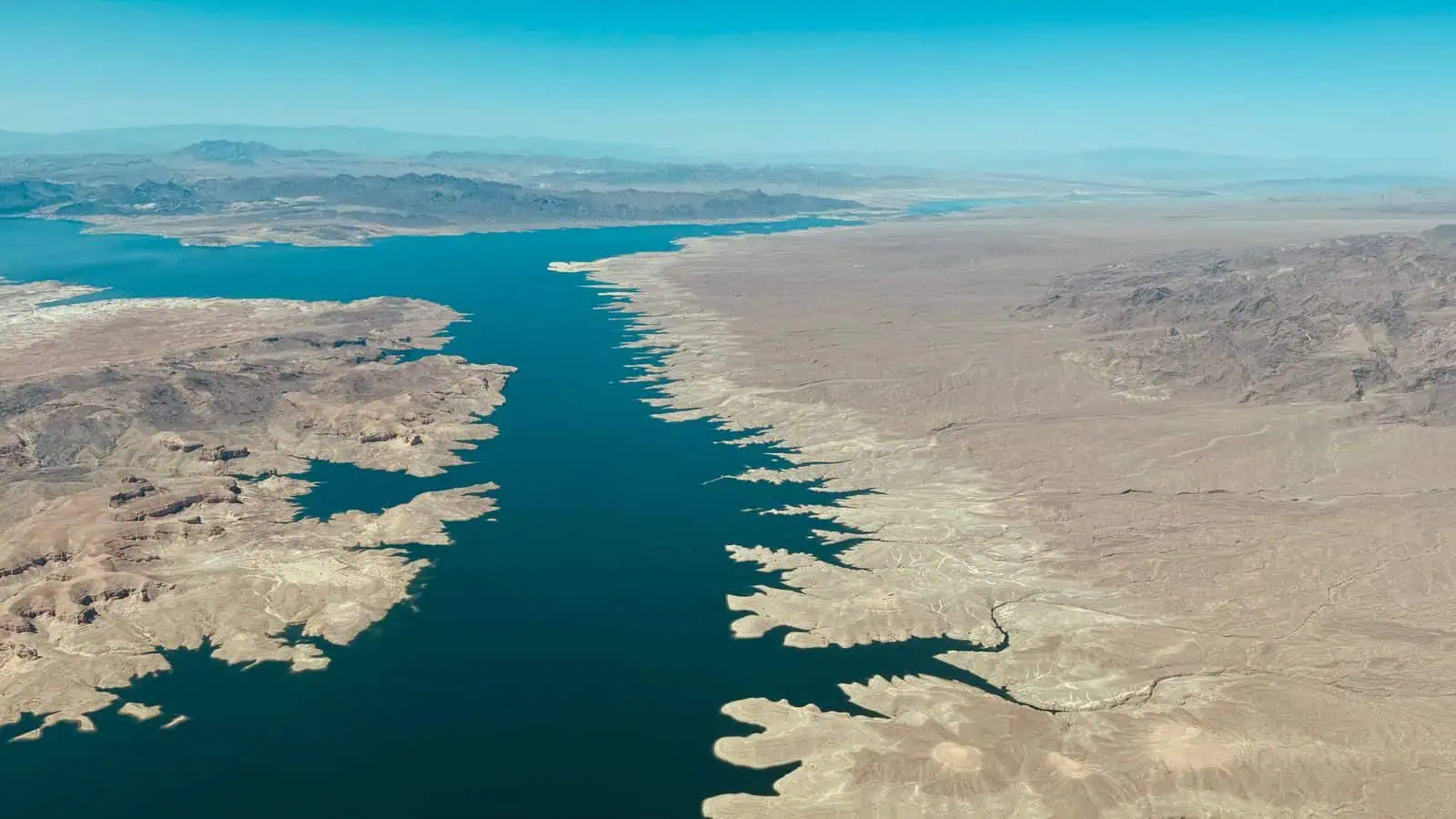
Ask any out of state investor what worries them about Las Vegas real estate and the first answer is almost never crime, taxes, or vacancy. It is water. They have seen the photos of the white mineral ring around Lake Mead and they want to know whether a city of 2.4 million people in the Mojave Desert is a safe place to own rental property for the next twenty years. It is a fair question, and it deserves a real answer built on numbers rather than headlines. The short version is that Las Vegas is not going to run out of water, but water policy is quietly one of the strongest forces propping up the value of existing rental housing in the valley. This article walks through why.
Where Las Vegas water actually comes from
Roughly 90 percent of Southern Nevada’s water supply is drawn from Lake Mead, the reservoir behind Hoover Dam that stores Colorado River water. The remaining 10 percent comes from groundwater pumped from the Las Vegas Valley aquifer, used mostly as a supplemental supply in peak summer months. The Southern Nevada Water Authority (SNWA), the wholesale agency formed in 1991, manages the regional supply for the member utilities that serve Las Vegas, Henderson, North Las Vegas, and Boulder City.
Nevada’s share of the Colorado River was set by the 1928 Boulder Canyon Project Act at 300,000 acre feet per year. That is the smallest allocation of any basin state. California holds 4.4 million acre feet and Arizona holds 2.8 million. An acre foot is about 326,000 gallons, roughly what two average Las Vegas homes use in a year under current conservation rates. On paper, 300,000 acre feet for a metro area of 2.4 million people looks impossibly thin. In practice it works, for a reason most investors have never heard of.
The recycling advantage that changes the math
Under the accounting rules that govern the river, Nevada is charged only for its consumptive use, meaning water that is diverted and not returned. Nearly every drop used indoors in the Las Vegas Valley, every shower, every dishwasher cycle, every toilet flush in every rental unit, is captured by the sanitary sewer system, treated to a high standard, and returned to Lake Mead through the Las Vegas Wash. Southern Nevada then receives return flow credits for that water, which allows it to divert well above 300,000 acre feet gross while staying inside its consumptive cap.
The practical effect is that indoor water use in Las Vegas is close to a closed loop. A tenant taking a long shower in a Spring Valley apartment is not meaningfully depleting the region’s allocation, because that water goes back to the lake and is counted as a credit. The water that is truly lost is outdoor use, primarily landscape irrigation, because water sprayed on grass evaporates or soaks into the ground and never reaches the Wash. That is why nearly all of Southern Nevada’s conservation policy targets turf, not people.
The results are hard to argue with. Between 2002 and today, Southern Nevada’s population grew by roughly 800,000 people while its total consumptive use of Colorado River water actually declined. Per capita use fell from over 300 gallons per day in the early 2000s to near 110 gallons today, and the SNWA’s adopted goal pushes that to 86 gallons by 2035. Assembly Bill 356, passed in 2021, requires the removal of nonfunctional grass (decorative turf in medians, office parks, and HOA common areas) by the end of 2026, a first in the nation mandate that continues to squeeze outdoor use down. For a rental owner, the operational translation is simple. Desert landscaping is not just cheaper to maintain, it is where the entire regulatory environment is heading, and properties converted early avoid both water bills and future compliance projects.
The elevation numbers that actually matter at Lake Mead
Media coverage of Lake Mead tends to treat every foot of decline as a countdown to catastrophe, so it helps to know which elevations carry real consequences. The lake is full at 1,229 feet above sea level. It peaked near 1,225 feet in the early 1980s, fell to a modern low of about 1,040 feet in July 2022, and has since recovered into the 1,060 to 1,080 foot range following strong snowpack years and aggressive basin wide conservation agreements. The Bureau of Reclamation publishes daily Lake Mead elevation data that anyone underwriting a Las Vegas purchase can check in thirty seconds.
Three thresholds matter most for Las Vegas specifically.
- 1,075 feet. Below this line the federal government declares a Tier 1 shortage under the 2007 Interim Guidelines and the 2019 Drought Contingency Plan. Nevada’s allocation is cut by 21,000 acre feet, with deeper cuts at 1,050 and 1,025 feet.
- 950 feet. Below this elevation Hoover Dam’s ability to generate hydropower degrades severely, a regional energy issue though not a Las Vegas supply issue.
- 895 feet. This is dead pool, the level at which water can no longer pass through Hoover Dam to downstream users in Arizona and California.
Here is the fact that separates Las Vegas from every other city on the river. Between 2008 and 2020, the SNWA spent roughly 1.5 billion dollars building a third intake that draws from the bottom of the lake at elevation 860 feet, plus a low lake level pumping station that can lift water even below dead pool. If Lake Mead ever fell so far that no water could physically leave the dam for Phoenix, Los Angeles, or the farm districts of the Imperial Valley, Las Vegas would still be pulling its supply from the deepest part of the reservoir. No other major user on the system has that insurance. Southern Nevada essentially prepaid for the worst case decades before it could arrive.
Shortage tiers have been absorbed without touching taps
Nevada has already lived under Tier 1 and Tier 2 shortage declarations in recent years, with cuts of 21,000 to 25,000 acre feet. Notice what did not happen. No Las Vegas resident lost water service, no rental property faced use restrictions beyond the existing landscape watering schedules, and no new home was denied a connection. The cuts were absorbed entirely because Southern Nevada was already using less than its full allocation, a cushion built by two decades of turf removal, golf course budgets, and the return flow credit system. The valley banked additional unused water in Lake Mead and in Arizona groundwater storage, reserves measured in the hundreds of thousands of acre feet.
The current operating rules expire at the end of 2026, and the seven basin states are negotiating the post 2026 framework now. Whatever emerges will almost certainly involve deeper cuts across the basin, because the river’s flows have declined about 20 percent since 2000. But the arithmetic of who feels those cuts is lopsided. Around 70 to 80 percent of Colorado River water goes to agriculture, most of it in California and Arizona. Municipal Southern Nevada, using under 2 percent of the river with a closed loop indoor system and the deepest straw in the lake, is structurally the last user in line to feel pain.
Why water policy constrains new supply, not existing homes
This is the part investors should actually care about, because it flips the story. Water in Southern Nevada is not a threat to existing rental housing. It is a brake on new competition.
Every new subdivision needs a will serve commitment from the water utility, and Nevada water law under NRS Chapter 533 and NRS Chapter 534 runs on prior appropriation, the doctrine that senior existing rights come ahead of new ones. Land supply compounds the effect. About 88 percent of Clark County is federally owned, and private development is largely confined to the disposal boundary set by the Southern Nevada Public Land Management Act of 1998. The valley is hemmed in by federal land, mountains, and a hard water budget. Developers cannot simply sprawl outward the way Phoenix or Dallas builders can, and SNWA has already signaled resistance to serving speculative development far outside the existing footprint.
Squeezed land plus capped water equals structurally constrained housing production in a metro that keeps adding people. We covered the demand side of that equation in our analysis of Las Vegas population growth and rental demand in 2026, and the supply side in our breakdown of new apartment supply and what it is doing to Las Vegas rents. The short version is that the apartment pipeline that delivered in 2023 through 2025 is thinning, single family construction is rationed by land auctions and infrastructure costs, and household formation has not slowed. A city that cannot easily overbuild is a city where existing rentals hold pricing power.
What this means for a rental owner’s underwriting
Pulling the threads together, here is how the IRES team would frame water for anyone modeling a Las Vegas purchase.
- Supply risk to your property is minimal. Existing homes sit on senior, protected municipal supply, behind a utility that can physically access water below dead pool and holds banked reserves.
- Operating costs favor desert ready properties. Water rates rise on heavy outdoor users. A rental with xeriscape and drip irrigation runs meaningfully cheaper than one with a thirsty lawn, and turf conversion rebates from the water authority can offset the switch.
- Scarcity supports rents and values. Constrained land and constrained water are the same tailwind that drives appreciation in the submarkets we profiled in our guide to the fastest growing Las Vegas neighborhoods. Growth is being channeled into infill and master plans inside the disposal boundary, which concentrates demand rather than diluting it.
- Watch the post 2026 negotiations, not the daily lake level. The elevation of Lake Mead on any given Tuesday is weather. The basin operating agreement is policy, and policy is what determines whether Nevada’s already small municipal share faces any new pressure.
None of this means water is a solved problem forever. It means Las Vegas confronted its constraint twenty years before its neighbors did, engineered around it, and turned it into a moat around existing housing stock. For owners, the practical work is at the property level, keeping irrigation compliant with watering schedules, converting turf while rebates last, and catching leaks before they become four figure bills. That is day to day blocking and tackling, and it is exactly the kind of detail a local manager handles. If you would rather have someone on the ground doing it, our Las Vegas property management team builds landscape and utility oversight into routine inspections for every home we manage.
The bathtub ring is real. So is the third intake sitting 200 feet below it. Investors who understand both halves of that picture tend to make better decisions than the ones who only saw the photo.
Need Help Managing Your Las Vegas Rental?
IRES takes the stress out of property management. Whether it’s tenant screening, lease enforcement, rent collection, or just getting your time back, we’ve got you covered.
Call us: 702-478-2242
Email: brandy@iresvegas.com
Or visit our Contact Page
This article provides general information about Nevada landlord-tenant law and federal fair housing requirements and should not be considered legal advice. For specific legal questions, consult a licensed Nevada attorney.