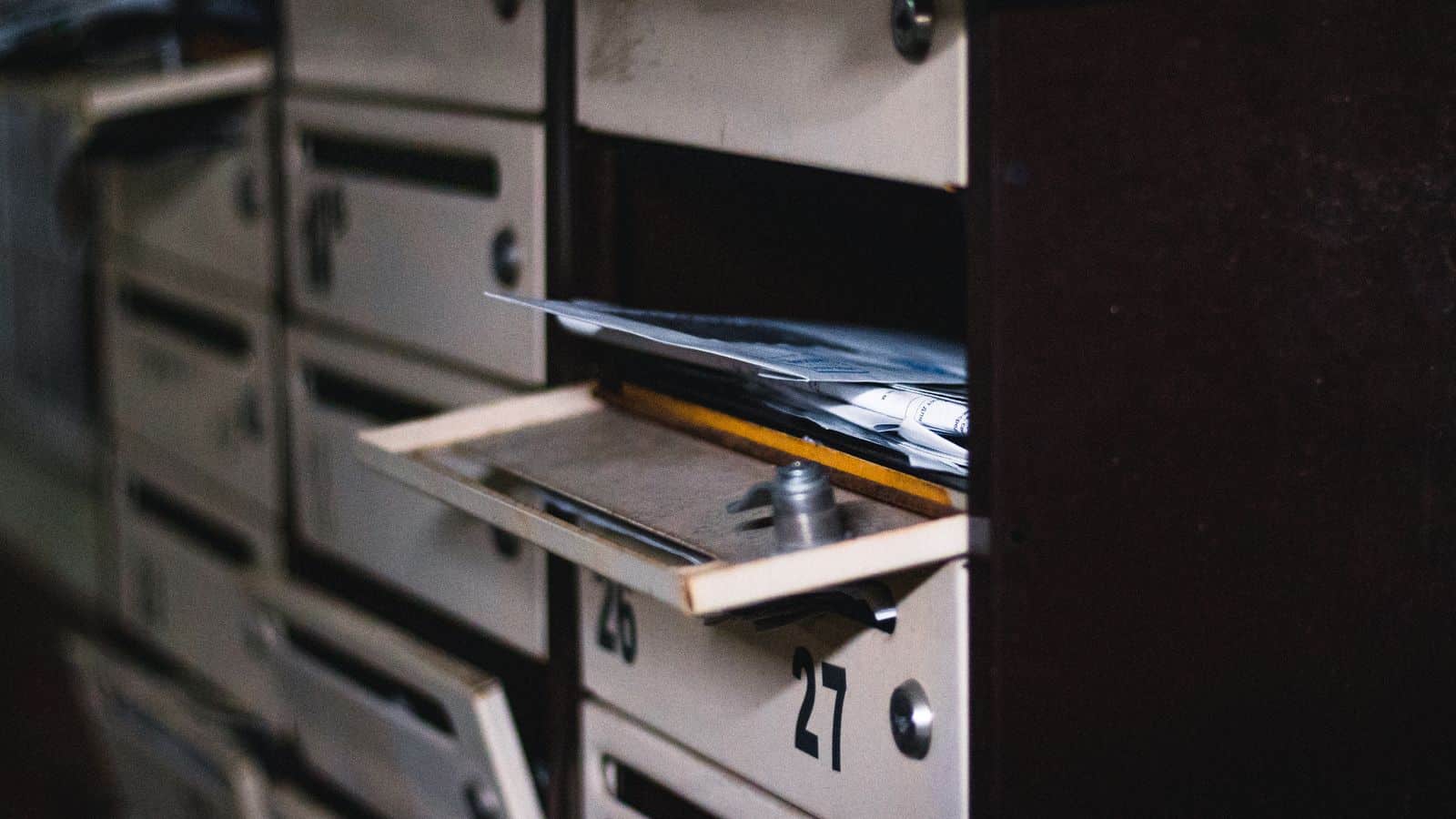
Mail for former tenant names keeps landing in the box of your Las Vegas rental, and the new resident asks what to do with it. The short answer is simple. Nobody opens it and nobody throws it away. It goes back into the mail stream, and the former tenant is the one who fixes the source. This guide covers what a property manager tells the new tenant, what the manager does itself, how cluster mailbox keys fit into turnover, and the few cases where old mail tells the owner something worth knowing.
Why does old mail keep arriving after a tenant leaves?
Mail follows the address on the envelope, not the person living there. When a tenant moves out and never files a forwarding request, every sender with the old address keeps using it. Banks, magazines, retailers, medical offices and government agencies update their records slowly, and some never do unless the person tells them.
The carrier delivers to the box assigned to your address. The carrier does not know your lease ended. So the first weeks after move-in bring a trickle of mail addressed to someone the new tenant has never met. It is almost always junk or routine statements, and it is annoying more than it is serious.
The pattern often reflects how a tenant left. One who gave notice and cleaned up may have filed a change of address. One who left in a hurry did not. If the departure was sudden, the guide on what landlords do next when a tenant leaves without notice covers the larger problem, and the mail question becomes one small part of it.
What should the new tenant do with the mail?
New tenants often feel responsible for solving a problem that is not theirs. A good move-in packet takes that weight off. It says the tenant did nothing wrong, that stray mail is normal after any turnover, and that the process is the same for everyone in the building.
Give the new tenant one clear instruction in the move-in packet. Do not open mail addressed to someone else. Do not throw it away. Mark it so the carrier can return it, and put it back into the outgoing mail.
The common practice is to write a short note on the envelope, such as “Not at this address, return to sender,” leave the rest of the envelope as it is, and drop it in a collection box or hand it to the carrier. Mail addressed to a person is that person’s mail, and a stranger who opens or discards it creates problems that a one-line instruction avoids. Telling tenants plainly spares them a mistake they might otherwise make out of tidiness.
Tell the tenant also what not to do. Do not write a forwarding address on the envelope unless you have one. Do not forward mail to the former tenant by hand on your own. Do not post a note on the mailbox naming the former tenant. Any of those can expose another person’s information to neighbors.
If the mail keeps coming for weeks, tell the tenant to give the pile to the management office instead. The manager can look at the senders on the outside, sort what needs attention, and decide what to do without opening anything.
What does the property manager do about it?
The manager’s job is to keep the pile small and the record clear. At move-out, the manager collects the former tenant’s forwarding address on the move-out checklist and notes it in the file. After move-in, the manager keeps the former tenant’s address on hand so mail the office receives can be sent on, and tells the new tenant to bring anything that looks important to the office.
A manager also logs what comes in. Not the contents, only the sender names visible on the envelope and the dates. A note that says “three envelopes from the same lender, 10 Nov” is enough to spot a pattern. If the same sender keeps appearing, the manager can contact the former tenant at the forwarding address and ask them to update that sender.
Some offices keep a short template message for the former tenant: your mail is still arriving at the rental, here is how to file a change of address, please update your senders. The tone is neutral. It is a courtesy, and it also keeps a record that you asked.
Nothing in this routine requires the owner to do anything. That is the point of having it written down. A managed property handles the stray envelope the same way every time.
What should the former tenant do?
The fix sits with the former tenant. The U.S. Postal Service explains how to file a change of address and forward your mail, and the page says standard forwarding lasts 12 months, with options to extend it. It also notes that a request takes effect some days after approval, so someone who files on move-out day will still see a gap of delivery to the old address.
The USPS page says you can file online or at a Post Office, and online filing requires identity verification. A manager cannot file for a former tenant, and the new tenant cannot either. The only person who can start forwarding is the one whose mail it is, or someone acting with proper authority for them.
That is why the manager’s note to the former tenant matters. A forwarding request is the single action that stops the flow at its source. Senders that do not honor the forward still have to be updated by the former tenant one by one, which is slow but entirely in their hands.
Include a line about forwarding in your move-out instructions. Tenants who hear it at the right moment are far more likely to do it than tenants who hear it after they are gone.
How do cluster mailbox keys work at turnover?
Many Las Vegas neighborhoods and condo communities use cluster boxes, where each home has a numbered compartment and a key. The key is a security item, and it belongs in your turnover routine next to the house keys.
At move-out, the manager should collect the mailbox key with the other keys and record how many came back. A former tenant who keeps the mailbox key can keep opening a box that is no longer theirs. That is a real exposure for the new tenant’s mail, and it is the easiest gap to prevent.
If a key is missing, the answer depends on who controls the lock. In some communities the post office handles the lock, and in others the association does. The manager should know which applies to each property and have the contact on file. Ask your manager for that detail in writing, along with the usual lead time for a lock change, so a lost key at turnover does not leave a new tenant waiting.
The broader subject of keys, rekeying and smart locks is covered in the piece on rekeying, smart locks and key handoff for Las Vegas rentals. Treat the mailbox key as part of that same chain, with its own line on the checklist.
What if the former tenant cannot be reached?
Sometimes the forwarding address is blank, the phone number is dead and the email bounces. The mail still arrives, and the routine still applies. The manager keeps unopened items that look personal or official in a labeled folder in the office, with the date received, and sends the rest back through the mail stream with the return note.
Set a holding rule so the folder does not grow forever. A manager might hold items for a defined period, try the last known contacts again, and then return them to the sender. The exact period is a decision for your management agreement. What matters is that it is written, applied the same way every time, and logged.
Do not let the pile move into a drawer in the owner’s home. Mail that sits in an owner’s kitchen for a year is a liability, because no one can show what happened to it. The office folder and its log are the safer home for it.
When the former tenant owes money and cannot be found, the mail question and the balance question meet. The envelopes on your desk may be one of the few clues to where the person went, so the log of senders is worth keeping even though you will never open the envelopes themselves.
What does the turnover checklist add?
The mail routine fits into the make-ready sequence with very little extra work. The walkthrough of a make-ready unit turn in Las Vegas already has the steps where the pieces belong. Three items cover it.
- At move-out, record the former tenant’s forwarding address, collect all mailbox keys, and note the box number.
- During the turn, check the box is empty, and bag any leftover mail unopened for the office. Confirm the lock works with the key the new tenant will receive.
- At move-in, give the new tenant the key, the one-paragraph mail instruction and the office contact.
Each item takes a minute. Together they stop most of the confusion before it starts. They also create a dated record that shows what was done, which helps if a former tenant ever claims their mail was mishandled.
When does old mail tell you something?
Most stray mail is noise. Some of it is a signal, and the owner is better off knowing. Repeated envelopes from collection agencies, law offices or courts addressed to the former tenant can mean the former tenant has other disputes, and it may also bear on a balance owed to you. A manager who notices that pattern should tell the owner what the outside of the envelopes shows, without opening them.
The same goes for anything that looks official and time sensitive. If an envelope looks like a court document, the manager should send it on to the former tenant’s forwarding address promptly, by a trackable method if one is available, and keep a note of the date. If there is no forwarding address, the manager holds it and records that fact.
Be careful about what you read into the outside of an envelope. A sender name tells you very little, and an owner should not draw conclusions about a person from it. Use it only as a prompt to check your own file: is the deposit accounted for, is the forwarding address current, has the former tenant been contacted.
Mail addressed to the property itself is different. Notices from the city, a utility, an association or a tax office that name the owner or the address belong to you and the manager, and they should be opened and handled the day they arrive.
What should you ask your property manager for?
Ask three questions. Is the forwarding address collected at move-out? Are mailbox keys part of the key count, with the lock contact on file? What is the written instruction the new tenant receives about mail for a previous resident? A good manager answers each in a sentence and shows you the form.
Ask also how the office handles mail that arrives there and who is allowed to look at it. A clear rule, such as sorting by the outside of the envelope and never opening anything, protects both the tenant and you. For owners who want one team running the checklist from notice to move-in, the services under property management in Las Vegas cover the turnover steps described here, and you can reach the office at 702-478-2242 with questions about a particular home.
A stray envelope is a small thing, and a written routine keeps it that way.