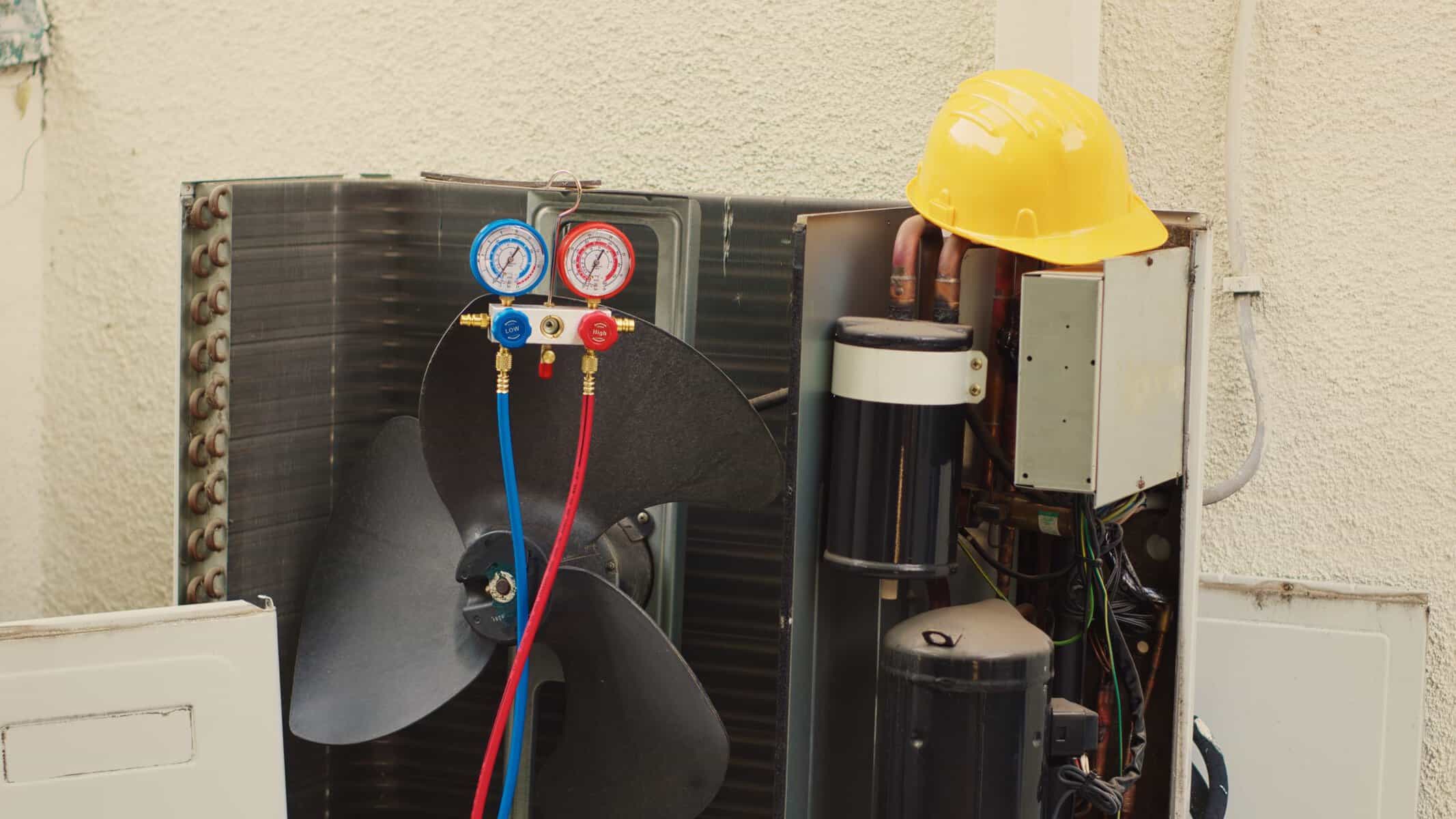
HVAC maintenance in a Las Vegas rental property takes more attention than nearly any other system, because the air conditioner runs harder, longer, and in more extreme conditions than virtually any other residential market. Your HVAC maintenance schedule begins with the fact that your air conditioner runs harder, longer, and in more extreme conditions than virtually any other residential market in the country, and when it fails in July, you’re not dealing with a maintenance ticket. You’re dealing with a habitability emergency where indoor temperatures can exceed 100°F within hours, tenant phone calls go from calm to hostile in a day, and every HVAC contractor in the valley is booked for a week.
This HVAC maintenance guide for Las Vegas rental property landlords covers the full cycle: seasonal service schedules, filter replacement cadence, the repair-vs-replace decision framework, tenant responsibilities, and the common failure modes that hit Las Vegas units hardest. For the broader seasonal maintenance picture beyond HVAC, see our Las Vegas Rental Property Maintenance Checklist.
For HVAC maintenance efficiency baselines and seasonal tune-up guidance, the U.S. Department of Energy Energy Saver program publishes detailed homeowner resources on central air conditioning systems and maintenance that landlords can reference when setting filter schedules and replacement decisions.
Why Las Vegas HVAC Maintenance Is Harder Than Almost Anywhere
A residential AC unit in a mild climate might run 500–700 hours per year. A Las Vegas unit runs dramatically longer, easily several multiples of the workload, with peak summer days demanding 16–18 hours of continuous operation when outside temperatures exceed 110°F. That kind of runtime compresses the functional lifespan of every component in the system.
Four factors make Las Vegas uniquely brutal on HVAC:
- Extreme ambient temperatures. When outdoor air is 115°F, the AC is working against a massive temperature differential. Compressors, capacitors, and fan motors all degrade faster under sustained high-heat operation.
- Desert dust. Fine particulate clogs filters in weeks, coats condenser coils, and infiltrates ductwork. A dirty condenser coil forces the compressor to work harder, raising operating temperatures and accelerating wear.
- Hard water. Las Vegas water is among the hardest in the U.S., mineral deposits build up on evaporator coils in systems with evaporative (swamp) cooler components and in humidifier-equipped units.
- UV degradation. Outdoor components, condenser housing, refrigerant line insulation, thermostat wiring exposed to sun, degrade faster under constant UV exposure.
The bottom line: an HVAC unit that would last 15–20 years in a moderate climate may only last 10–14 years in Las Vegas. Planning around that compressed timeline is what separates proactive landlords from the ones paying emergency premiums in July.
Seasonal HVAC Maintenance Schedule for Las Vegas Rentals
Spring (March–April), Pre-Summer Service
This is the most important service window of the year. Schedule a licensed HVAC technician for a full tune-up before demand spikes:
- Check refrigerant charge and inspect for leaks
- Clean condenser coils (outdoor unit)
- Inspect and test capacitors, contactors, and fan motors
- Verify thermostat calibration and operation
- Check ductwork for leaks or disconnected sections (especially in attics, Las Vegas attic temperatures can exceed 150°F
- Replace air filter
- Clear the condensate drain line (clogs are a top summer failure mode)
Cost for a standard tune-up runs $100–$200. This is the cheapest maintenance dollar you’ll spend all year. For the broader spring prep checklist covering all systems, see Prepare Your Las Vegas Rental for Summer Heat.
Summer (May–September), Filter Cadence and Monitoring
During peak summer, the priority shifts to keeping the system running clean:
- Replace or clean air filter every 30 days (not 90, Las Vegas dust loads demand monthly replacement during summer)
- Monitor condenser area, keep 2+ feet of clearance around the outdoor unit, remove any debris or landscaping encroachment
- Respond immediately to any tenant report of reduced cooling, unusual noises, or ice on refrigerant lines
A tenant complaint about weak cooling in July is not something that can wait until next week. For landlord response obligations, see My Tenant Says AC Is Broken, How Long Do I Have to Fix It?.
Fall (October–November), Transition Service
After five months of continuous summer operation, the system has taken its hardest beating:
- Replace air filter
- Inspect the heat exchanger and ignition system before heating season
- Test heating mode, Las Vegas winters are mild but nighttime lows can drop into the 30s (December–January), and tenants expect working heat
- Clean or replace the return air vent covers (dust accumulation is heaviest after summer)
Winter (December–February), Monitoring Only
Las Vegas heating demand is light compared to summer cooling, so winter is the lowest-maintenance HVAC season. Replace the filter once in January. Verify the thermostat is switching correctly between heat and cool mode. No professional service typically needed unless the fall inspection flagged something.
Filter Replacement, The HVAC Maintenance Task Landlords Get Wrong Most
A clean filter is the single most cost-effective way to extend HVAC life, reduce energy costs, and prevent the three most common failure modes (compressor overheating, frozen evaporator coils, and blower motor burnout). A dirty filter is the single most common cause of preventable HVAC failure in Las Vegas rentals.
Recommended replacement cadence for Las Vegas:
- Summer (May–September): Every 30 days
- Rest of year: Every 60–90 days
- Homes with pets, smokers, or heavy dust exposure: Every 30 days year-round
Who pays for filters?
This should be spelled out in the lease. Most Las Vegas property managers make filter replacement a tenant responsibility, the tenant buys the filters and replaces them on schedule. The lease should specify: filter size, replacement cadence, and a clause stating that HVAC damage caused by a clogged filter (provably neglected) may be charged to the tenant. Some landlords supply the filters quarterly via mail to eliminate excuses, a $30 investment that prevents a $5,000 compressor replacement.
Filter type: For most Las Vegas rentals, a standard MERV 8–11 pleated filter balances airflow and filtration. Higher-MERV filters (13+) restrict airflow and can strain the blower motor, don’t use them unless the system is specifically designed for high-MERV filtration.
Repair vs. Replace, When to Stop Fixing and Start Replacing
Every aging HVAC unit eventually reaches the point where another repair costs more than the remaining useful life justifies. In Las Vegas, that point comes earlier than most landlords expect.
Use this framework:
- The $5,000 rule. Multiply the age of the unit (in years) by the cost of the proposed repair. If the result exceeds $5,000, replace. Example: a 10-year-old unit needing a $600 repair = $6,000 → replace. A 5-year-old unit needing a $600 repair = $3,000 → repair.
- Refrigerant phase-out. If the unit uses R-22 refrigerant (Freon), replacement is overdue. R-22 has been phased out under EPA regulation, and the remaining supply commands extreme prices, $100–$200+ per pound, where a typical recharge requires 5–10 pounds. A single recharge can cost as much as a new unit’s down payment.
- Two or more major repairs in 12 months. A compressor replacement followed by a blower motor six months later is a pattern, not bad luck. The system is telling you it’s done.
- Energy efficiency. A 15-year-old unit runs at substantially lower efficiency (SEER 10–12) than a modern unit (SEER 14–16+). The monthly energy savings on a new unit can offset $50–$100/month in financing costs, meaning the upgrade is partially self-funding.
A new HVAC system for a typical Las Vegas single-family home runs $6,000–$12,000 installed, depending on size, brand, and ductwork needs. Expensive, but less expensive than three emergency repairs, a month of portable AC units, and a tenant who doesn’t renew.
Tenant HVAC Maintenance Responsibilities and Lease Language
HVAC maintenance is a shared responsibility, and the lease needs to draw the line clearly. Ambiguity in the lease is how landlords end up paying for damage caused by tenant neglect, and how tenants end up complaining about issues they should have reported weeks earlier.
Tenant responsibilities (specify in lease):
- Replace air filter on the schedule specified in the lease (landlord provides filter size)
- Keep the thermostat at or above 72°F during cooling season (prevents frozen coils and compressor strain)
- Keep 2+ feet of clearance around the outdoor condenser unit
- Report any performance issues (weak cooling, unusual noises, ice, water leaks) immediately
- Do not block or close supply vents or return air grilles
Landlord responsibilities:
- Provide a working HVAC system that maintains habitable conditions per NRS 118A.290
- Schedule and pay for professional maintenance (spring tune-up, fall inspection)
- Respond to emergency AC failures within 24–48 hours during summer (standard expectation in Las Vegas, even absent a specific statutory timeline)
- Replace the system when repairs are no longer cost-justified
For the full picture on landlord repair obligations and what qualifies as an emergency, see Emergency Repairs: What Counts and Response Timelines.
Most Common HVAC Maintenance Failures in Las Vegas Rentals
Four failure modes account for the vast majority of Las Vegas HVAC service calls:
- Capacitor failure. Capacitors weaken under sustained heat. Symptoms: unit hums but won’t start, or starts sluggishly. Replacement cost: $150–$400. This is the most common and cheapest repair, but if it happens repeatedly, it signals the compressor is drawing too much current.
- Condensate drain clog. Algae and mineral deposits block the drain line, causing water backup and potential ceiling/floor damage. Symptoms: water pooling near the indoor unit or musty smell. Prevention: flush the drain line with vinegar or bleach annually (part of the spring tune-up).
- Compressor burnout. The most expensive failure, $1,500–$3,000+ for replacement. Usually caused by chronic low refrigerant, dirty coils, or electrical issues that went unaddressed. On older units, compressor replacement often triggers the replace-the-whole-system conversation.
- Refrigerant leak. Low refrigerant forces the system to work harder and eventually freezes the evaporator coil. Symptoms: ice on the refrigerant line, warm air from vents. Repair cost depends on leak location and refrigerant type, R-410A is reasonable R-22 is prohibitively expensive.
This Is What IRES Handles for You
HVAC management is where self-managing landlords most often overspend, either by skipping maintenance until an emergency hits, or by pouring money into repairs on a unit that should have been replaced two years ago. At IRES, our property maintenance and repairs service includes scheduled spring and fall HVAC service, a vetted network of licensed Las Vegas HVAC contractors, and a replace-vs-repair recommendation for every unit we manage based on age, condition, and repair history.
For a full breakdown of what professional management costs, including how maintenance coordination fits into the fee structure, see How Much Does Property Management Cost in Las Vegas?. And for the complete scope of what we handle, see our property management services.
For the full scope of how we manage Las Vegas rentals end to end, see our property management services.
Need Help Managing Your Las Vegas Rental?
IRES takes the stress out of property management. Whether it’s tenant screening, lease enforcement, rent collection, or just getting your time back, we’ve got you covered.
Call us: 702-478-2242
Email: brandy@iresvegas.com
Or visit our Contact page
This article provides general information about Nevada landlord-tenant law and federal fair housing requirements and should not be considered legal advice. For specific legal questions, consult a licensed Nevada attorney.